Local Governent Reorganisation

In December 2024, the government published the English Devolution White Paper. This outlined its plans for transferring more powers from national government to local areas. This is called devolution. Devolution will be achieved by creating strategic authorities with elected mayors.

Councils across the country were invited to be one of the first strategic authorities as part of the Government’s Devolution Priority Programme. Kent and Medway put forward a bid to be part of this programme but were not selected.

Local Government Reorganisation

The White Paper also included the government’s plans for simpler council structures, with residents served by just one local council (known as a ‘unitary council’). This is known as Local Government Reorganisation (LGR).

Kent currently has two layers of local government. Kent County Council looks after some services (like education, highways, libraries, children’s services and social care) and the 12 borough and district councils (including Dartford Borough Council) deliver the other local services (such as planning, waste collection, parks and open spaces, housing, environmental health, licensing and council tax). This two tier structure will be replaced with a single unitary council that will provide all of the services listed above, to a population of around 500,000.

The government has asked all two tier areas to work up proposals for moving to unitary councils. Interim proposals were submitted by the Kent authorities on March 21, 2025, with detailed proposals due to be sent to government by November 28, 2025.

November 5

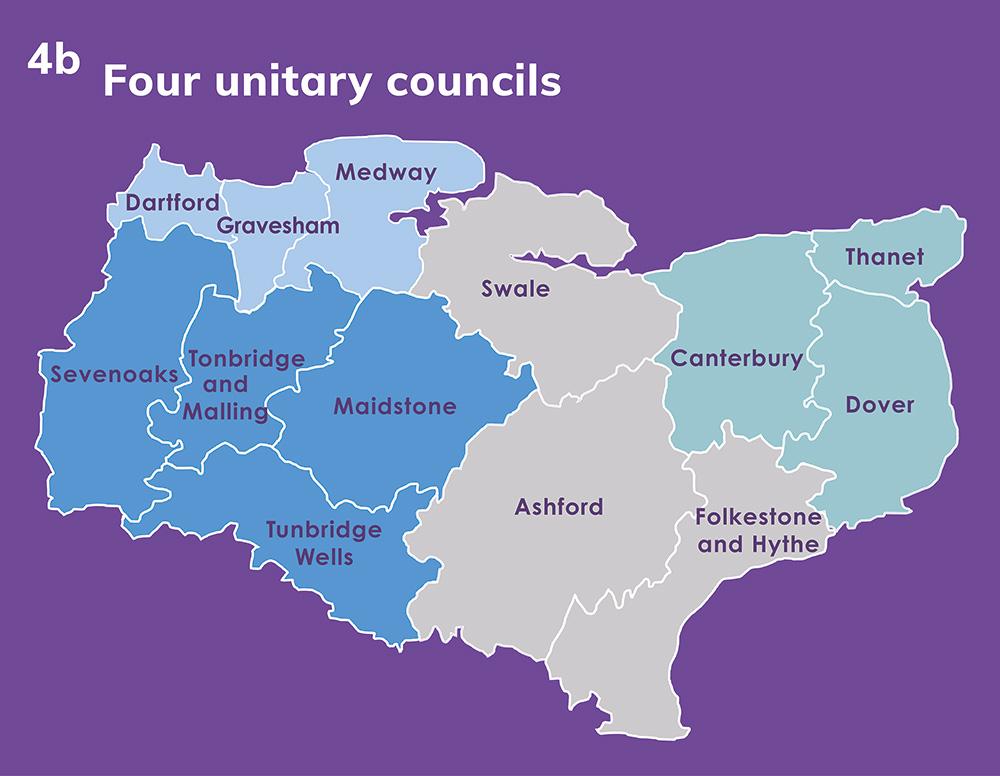
On November 5 Kent Council Leaders shared their draft business cases that suggest several different options for how the unitary councils will be mapped out. You can view Dartford Borough Council's preferred option, 5a, above.

The cases, compiled with the help of experienced advisers KPMG, explore different options for the number of unitary councils in Kent and the areas they should cover in the future. 

Week commencing November 17

The options for LGR across Kent & Medway were discussed at the General Assembly of the Council (GAC) on Monday, November 17.

After a long debate, GAC voted to recommend option 5a (five unitary authorities across Kent) to Cabinet. Of the 35 members in attendance when the vote was taken, 26 members voted for option 5a, seven members voted for option 4d (four unitary authorities but with some boundary changes) and two members abstained.

On Thursday, November 20, Cabinet then discussed the recommendation from GAC. Concerns were raised over the principle of LGR and the timeline for implementation, but members did agree to support option 5a as being the best of the options on the table.

November 28

On Friday, November 28, we submitted the business case for option 5a as our preferred option to MHCLG.

All of the councils in Kent and Medway submitted their preferred option for the number of unitaries and the geographical areas they should cover.

We all continue to push the government for devolution for Kent which would mean powers, decision making and money flowing into the county from ministers and civil servants in Whitehall. This means we would have more control over our own destiny through the creation of a mayor and strategic authority. As yet, nothing has been confirmed as to when, or indeed if, Kent will received devolution.

What happens next?

Civil servants will look at the business case for each option – you can read them here: Your councils – change is coming - Kent Council Leaders - and will assess them against the government’s criteria.

It is our understanding those that meet the criteria will be consulted on by the government early next year.

They will need our support to push the consultation out as widely as possible. Once the consultation has finished and the feedback has been analysed, ministers will make the final decision.

The new councils do not come into being until April 2028.

Find out more about LGR and what it means for you.